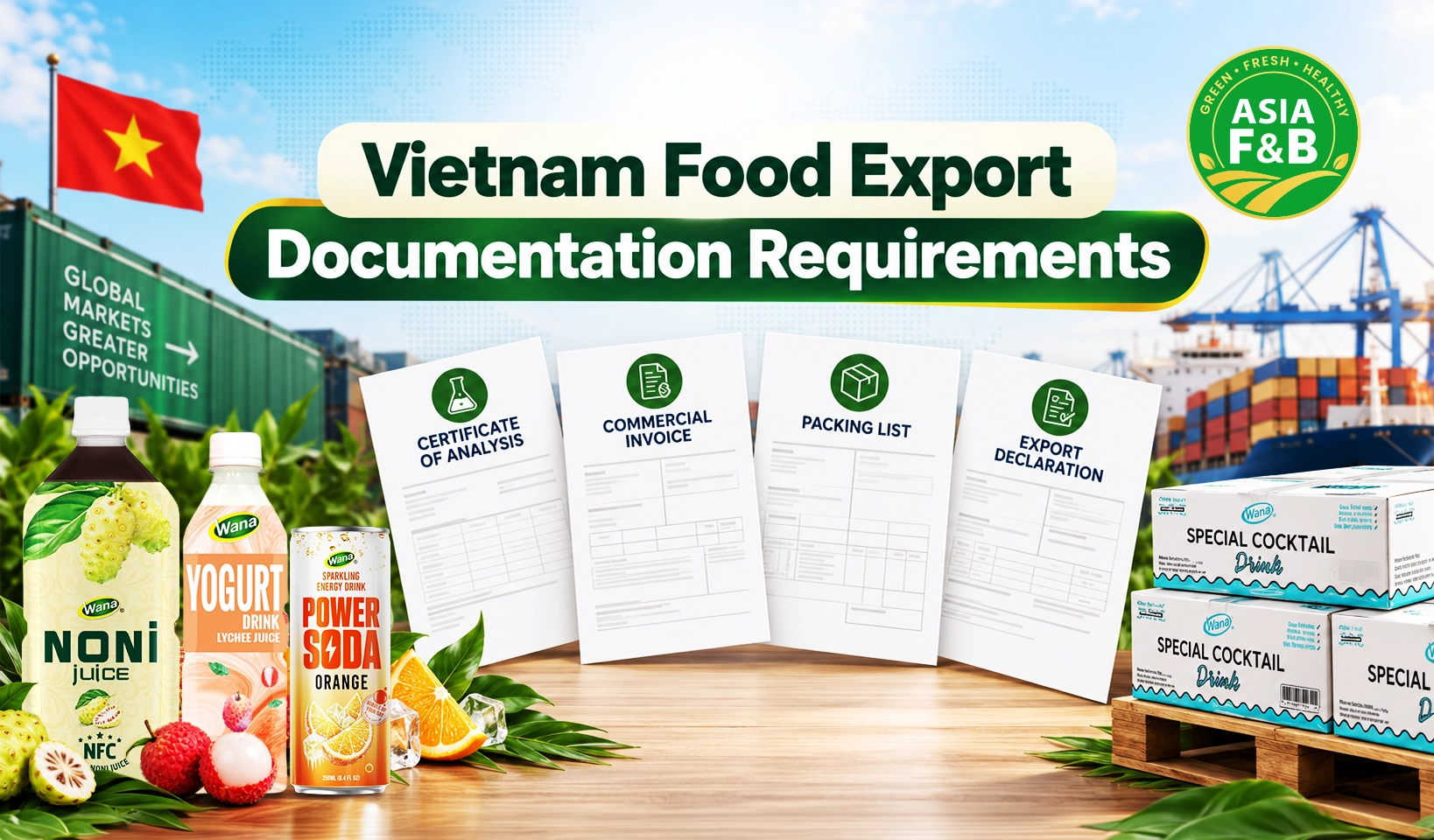
Vietnam food export documentation requirements are an important part of sourcing food and beverages from Vietnam. However, there is no single set of documents that applies to every food shipment.
Missing, inaccurate, or inconsistent documents can lead to customs delays, additional costs, or difficulties during import clearance.
This guide explains the key Vietnam food export documents that international buyers should understand, what may be required for different food products, and what to check with a Vietnamese food supplier before shipment.
What Is Export Documentation for Food Products?
Export documentation refers to the documents needed to ship goods from one country to another. For food products, these documents provide important information about the product, shipment, origin, and compliance requirements.
Common information may include:
- Buyer and seller details
- Product name and quantity
- Shipping and transportation details
- Country of origin
- Product specifications
- Food safety and testing information
- Required certificates
These documents help exporters, importers, customs authorities, and logistics providers verify the shipment and complete customs clearance.
However, export documents are not always the same as import documents. A food product shipped from Vietnam may require additional documents when it enters the destination country.
Therefore, importers should check the requirements of their destination market and confirm the necessary documents with their Vietnamese supplier before production and shipment.
What Documents Are Needed When Sourcing Food from Vietnam?
The documents required when sourcing food from Vietnam depend on the product, destination market, shipping method, and applicable regulations. For international buyers, these documents can generally be organized into three main groups.
1. Commercial & Shipping Documents
These documents support the commercial transaction and transportation of the goods.
- Commercial Invoice – Provides information about the buyer, seller, products, quantity, price, value, currency, and other transaction details.
- Packing List – Provides information about the packaging, number of cartons, quantities, net and gross weight, and other shipment details.
- Bill of Lading (B/L) or Air Waybill (AWB) – Provides transportation and cargo information. A B/L is generally used for sea freight, while an AWB is used for air freight.
- Sales Contract, where applicable – Defines the agreed product, price, quantity, payment terms, delivery terms, and other commercial conditions.
2. Customs & Origin Documents
These documents support customs procedures and establish information about the classification and origin of the goods.
- Export Customs Declaration – Contains information submitted for customs clearance when goods are exported from Vietnam.
- Certificate of Origin (C/O) – Confirms the origin of the goods and may support preferential tariff treatment when applicable trade-agreement requirements are met.
- HS Code Information – Identifies the customs classification of the product and may affect duties, taxes, customs procedures, and applicable import requirements.
3. Food Safety & Product-Specific Documents
These documents relate to the safety, quality, characteristics, and specific regulatory requirements of the food product.
- Product Specification – Provides information about ingredients, formulation, nutrition, shelf life, storage conditions, packaging, and other product characteristics.
- Certificate of Analysis (COA) – Provides laboratory testing or quality information for a specific product or batch, where applicable.
- Health Certificate – May be required depending on the product, destination country, and applicable regulations.
- Phytosanitary Certificate – May apply to certain agricultural and plant products subject to plant-health requirements.
- Certificate of Free Sale (CFS) – May be requested for certain products or destination markets.
- Halal and Other Market-Specific Certifications – May be required depending on the destination market, product, and buyer requirements.
Not every shipment requires every document listed above. Importers should confirm the exact documentation requirements based on the specific product and destination market before production and shipment.
Case Study: Bottled Fruit Juice from Vietnam to the U.S.
A Vietnamese exporter shipping bottled fruit juice to the U.S. needs standard shipping documents, product specifications, test results, and compliant English labels. The juice processor must meet applicable FDA and Juice HACCP requirements, while the U.S. importer must submit Prior Notice and comply with applicable import verification requirements.
Before shipment, the buyer and supplier should cross-check all documents, labels, and product requirements to help ensure smooth customs clearance.
How to Check Food Export Documents Before Shipment
Importers should review export documents early to ensure that the shipment meets the requirements of the destination market and avoid delays during customs clearance.
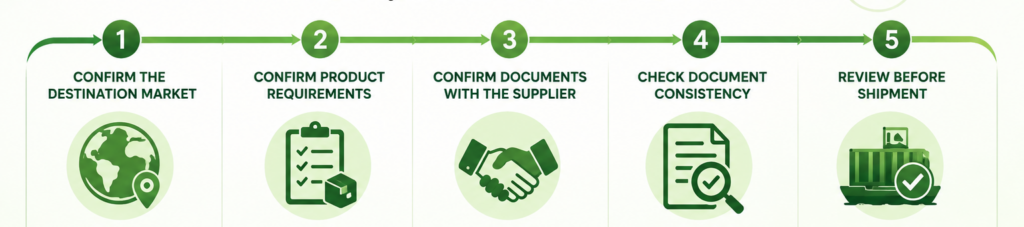
Step 1: Confirm the Destination Market
Check the food import, labeling, certification, and customs requirements of the destination country. Requirements may vary between the United States, European Union, Middle East, ASEAN, and other markets.
Step 2: Confirm Product Requirements
Review the product category, formulation, ingredients, Product Specification, packaging, shelf life, storage conditions, labeling, and applicable food safety requirements.
For OEM, ODM, or private-label products, buyers should also confirm custom formulation and packaging requirements to ensure that the final product meets the target market’s requirements..
Step 3: Confirm Required Documents With the Supplier
Ask the Vietnamese supplier which documents and certificates are available for the selected product and which documents can be provided for the specific destination market.
At the same time, confirm key sourcing details such as MOQ, production lead time, sample availability, packaging options, product specifications, shelf life, and pricing before placing an order.
For international shipments, buyers should also agree on relevant payment terms and Incoterms, such as FOB or CIF, before finalizing the order.
Step 4: Check Document Consistency
Compare the information across all documents and make sure key details match, including:
- Product name
- Product specification
- Quantity
- Packaging
- Net and gross weight
- Batch or lot number
- Exporter and importer information
- Country of origin
- Shipment details
Consistent information across the document set can help reduce questions or delays during customs clearance.
Step 5: Review Before Shipment
Review the complete document set before the goods leave Vietnam.
Make sure all required documents are complete, valid, and consistent with the final products and shipment details. Identifying missing or incorrect documents early gives the supplier and other parties time to make corrections before shipment.
This final review can help reduce the risk of customs delays, additional storage or handling costs, shipment delays, and last-minute document corrections.
Common Documentation Mistakes When Importing Food From Vietnam
Documentation problems can create delays even when the products themselves meet quality requirements.
Common issues include:
- Incorrect product descriptions
- Inconsistent quantities or weights between documents
- Incorrect HS codes
- Missing Certificate of Origin
- Expired or inappropriate certificates
- Incorrect importer or consignee information
- Missing batch or lot information
- Certificates that do not meet destination-market requirements
- Documents prepared too late
The best approach is to establish a document checklist at the beginning of the sourcing process and have both the supplier and importer review it before shipment.
How Asia F&B Supports International Food Importers
Asia F&B supports international B2B buyers sourcing food and beverages from Vietnam through product development, manufacturing, documentation, and export coordination.
Depending on the product and destination market, buyers can request support with:
- Product specifications & formulation
- Ingredients, nutrition & testing
- Packaging, labeling & customization
- Samples, MOQ & production lead time
- Food safety certifications & export documentation
- OEM, ODM & private label production
Asia F&B works with international buyers to develop food and beverage products according to their target market, product specifications, packaging requirements, and sourcing needs.
Frequently Asked Questions
What documents are needed to import food from Vietnam?
Common documents include the Commercial Invoice, Packing List, Bill of Lading or Air Waybill, and Certificate of Origin where required. Additional documents such as product specifications, COA, Health Certificates, or Phytosanitary Certificates may be required depending on the product and destination market.
Who is responsible for preparing food export documents?
Responsibility depends on the document. The exporter, manufacturer, freight forwarder, customs broker, certification body, and relevant authorities may each be involved in preparing or issuing different documents.
Importers should clarify responsibilities with the supplier before production and shipment
Do I need a Certificate of Origin when sourcing food from Vietnam?
It depends on the destination market and the purpose of the shipment. A Certificate of Origin may be required by customs or used to support preferential tariff treatment under an applicable trade agreement.
What documents should I request from a Vietnamese food supplier?
At the sourcing stage, importers should request the product specification, ingredients, shelf life, packaging information, relevant certifications, COA or testing information where applicable, and confirmation of available export documents.
How can I avoid documentation problems when importing food from Vietnam?
Confirm destination-market requirements before production, create a document checklist, communicate the requirements clearly to the supplier, and cross-check all documents before shipment.
In Conclusion
Successful food sourcing from Vietnam requires both the right supplier and the right documentation. The documents required depend on the product, destination country, shipping method, and applicable import regulations.
To avoid delays and additional costs, importers should confirm documentation requirements with their supplier and relevant authorities before production and shipment.
Looking for a reliable Vietnamese food supplier? Contact Asia F&B to explore our food and beverage products, request product information, and discuss your OEM, ODM, or private label requirements.