Knowing how to find Vietnamese food & beverage suppliers involves more than searching for the lowest price or the largest product portfolio. B2B buyers need to identify potential suppliers, evaluate their products and capabilities, and determine whether they are suitable for their target market and commercial requirements.
This guide explains how to find Vietnamese food & beverage suppliers, what to consider during the supplier discovery process, and how to select the right business partner for your sourcing needs.
Why Finding the Right Food and Beverage Supplier Is Important?
Finding the right Vietnamese food & beverage supplier can have a significant impact on sourcing efficiency and long-term business growth.
The right supplier can help buyers:
- Find products that fit their target market.
- Save time during the supplier discovery process.
- Reduce sourcing complexity.
- Receive clearer product and commercial information.
- Reduce potential sourcing risks.
- Launch products in the market faster .
- Build more stable, long-term business relationships.
Therefore, the goal is not simply to find the largest product portfolio or the lowest price. Instead, buyers should look for a reliable food and beverage supplier that can provide products and business support aligned with their market and commercial requirements.
Key Factors to Consider When Finding Vietnamese Food and Beverage Suppliers
Product Range and Market Fit
A large product portfolio does not always mean a better sourcing opportunity. More importantly, buyers need to determine whether the available products fit their target market and business strategy.
Consider the following questions:
- Which product categories are relevant to your customers?
- Are the flavors suitable for your market?
- Does the packaging fit your distribution channels?
- Does the product match your target price segment?
Ultimately, the best sourcing relationships are built around finding the right products for the right market.
Product Information and Documentation
Clear product information is essential when sourcing food and beverage products internationally. Depending on the product and destination market, buyers may need information such as:
- Product specifications
- Ingredient and nutrition information
- Allergen information
- Shelf-life details
- Packaging specifications
- Available certifications
- Product testing information
- Product images
- Export-related documentation
In addition, a reliable supplier should clearly explain which information is currently available and what additional requirements may need to be prepared.
Pricing, MOQ and Commercial Terms
Price should not be the only factor when comparing suppliers. Buyers should also understand:
- Product pricing
- MOQ
- Payment terms
- Lead times
- Packaging requirements
- Shipping arrangements
- Incoterms
- Potential export-related costs
For example, the lowest unit price does not always result in the lowest total sourcing cost. A cheaper product may involve a higher MOQ, longer lead times, additional logistics costs, or other expenses that were not included in the initial quotation.
Export Experience and Logistics Support
International sourcing involves more than simply selecting products. Buyers should therefore understand whether a supplier can support overseas orders and relevant export requirements.
Important questions include:
- Which international markets do they currently serve?
- Do they understand export procedures?
- What documents can they provide?
- Can they support logistics coordination?
- Are international commercial terms clearly understood?
For first-time buyers sourcing from Vietnam, experience with international orders can make the overall process easier to manage.
Communication and Responsiveness
Communication is also an important factor when evaluating a potential business partner. During the sourcing process, pay attention to:
- Response time
- Clarity of communication
- Product knowledge
- Consistency of information
- Willingness to answer questions
- Understanding of business requirements
Poor communication at the beginning can create bigger problems later when orders, product approvals, documents, and shipments are involved. Therefore, a reliable partner should provide clear and realistic information rather than making promises they cannot support.
A Practical Selection Process for B2B Buyers
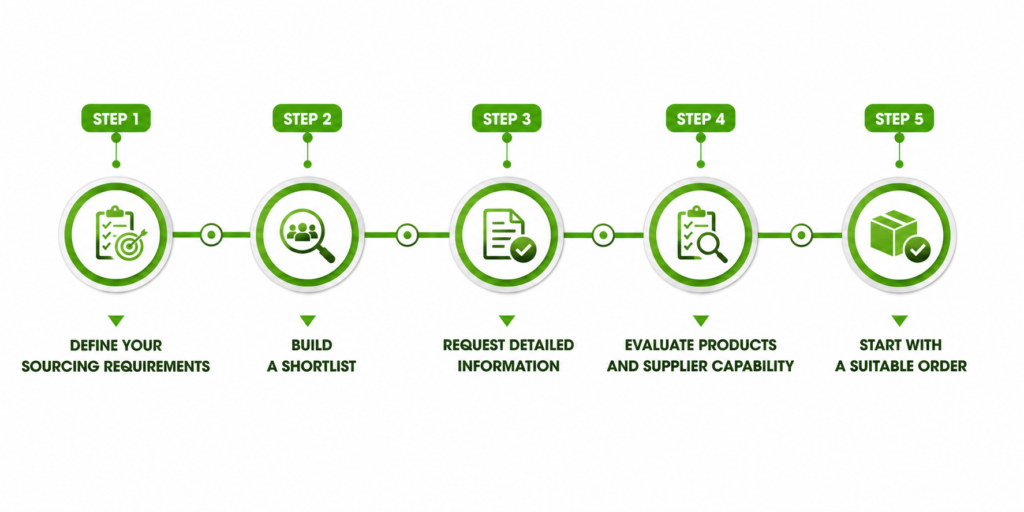 Step 1: Define Your Sourcing Requirements
Start by clearly defining what you are looking for before contacting potential suppliers. This may include your product categories, target market, price range, expected order quantity, packaging preferences, certification requirements, and delivery needs.
As a result, clear sourcing requirements make it easier to identify products and suppliers that fit your business needs.
Step 2: Build a Shortlist
Next, identify several potential suppliers and compare them based on product range, market fit, available information, commercial terms, export capabilities, and communication quality.
At this stage, you can eliminate suppliers that do not meet your basic requirements and focus on the most suitable options.
Step 3: Request Detailed Information
Once you have created a shortlist, request more detailed product and commercial information. This may include product catalogs, specifications, ingredient details, pricing, MOQ, lead times, packaging options, available certifications, and export documentation.
With this information, buyers can compare potential suppliers more accurately and identify possible gaps before moving forward.
Step 4: Evaluate Products and Supplier Capability
Before placing an order, evaluate both the products and the supplier’s ability to meet your requirements. For example, this may involve reviewing product information, requesting samples, or, where appropriate, visiting the supplier or meeting the team in person.
In addition, consider product quality, market fit, communication, commercial flexibility, and the supplier’s ability to coordinate orders and export requirements.
Step 5: Start with a Suitable Order
For a new business relationship, consider starting with an order size that allows both sides to evaluate the cooperation process. This approach can help assess product suitability, communication, order processing, documentation, and delivery coordination.
If the process runs smoothly, the relationship can then develop into a stronger long-term partnership.
Red Flags to Watch When Finding Vietnamese Food and Beverage Suppliers
Not every supplier will be suitable for your business. Therefore, buyers should be cautious when they encounter the following situations:
- Inconsistent or Changing Information: Product details, prices, or commercial terms change frequently without a clear explanation.
- Unrealistic Commitments: The supplier promises to meet every requirement without clearly explaining its actual capabilities.
- Lack of Transparency: Important information about pricing, documentation, product availability, or business terms is unclear or avoided.
- Pressure to Make a Quick Decision: The buyer is pushed to place an order before having enough time to evaluate products and commercial terms.
These warning signs do not always mean that a supplier is unreliable. However, they should encourage buyers to ask more questions and conduct further evaluation before making a commitment.
Partner with Asia Food & Beverage JSC – Asia F&B
Asia Food & Beverage JSC – Asia F&B is a Vietnam-based company specializing in food and beverage brand development, international trade, and global distribution.
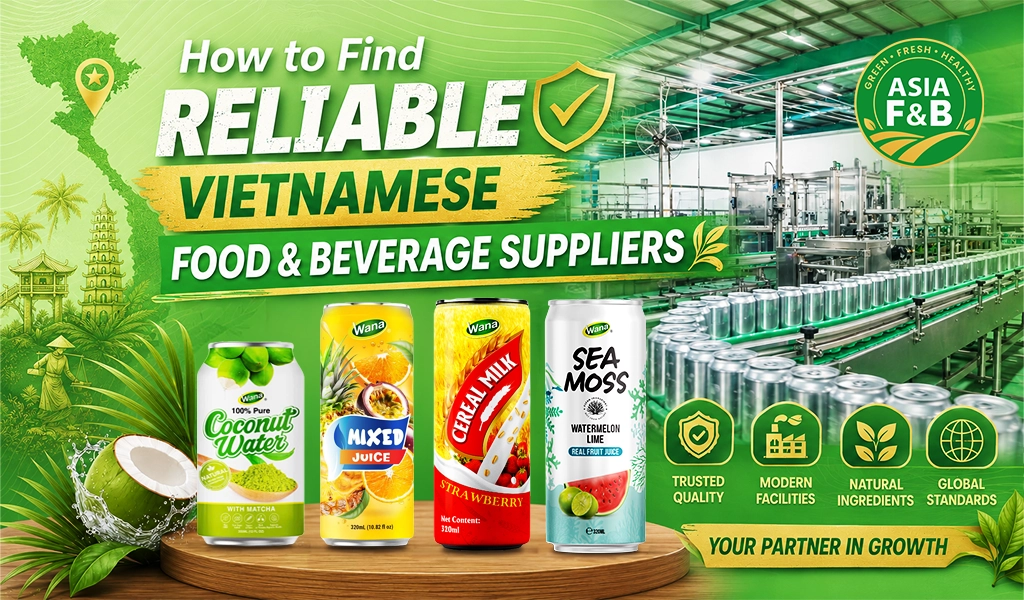
Asia F&B offers a range of food & beverages, including coconut water, aloe vera drinks, fruit juice, processed food,…To support B2B buyers, Asia F&B can:
- Exploring products that fit their target market.
- Providing product and commercial information.
- Discussing product requirements, pricing, and MOQ.
- Providing available product information and documentation.
- Supporting communication throughout the business process.
- Assisting with order and export coordination.
For Asia F&B products, the standard MOQ is one 20-foot container, approximately 50,000 cans. Asia F&B’s certifications include FDA, Halal, ISO 22000, FSSC 22000, BRCGS, SEDEX, USDA Organic,… depending on the product and market requirements.
For importers, distributors, retailers, and other B2B buyers, Asia F&B can be a reliable partner for sourcing Vietnamese food and beverage products for international markets.
Frequently Asked Questions
Where Can I Find Food and Beverage Suppliers in Vietnam?
To find food & beverage suppliers in Vietnam, buyers can use online B2B platforms, browse local business directories, attend trade fairs, or contact suppliers directly through their websites. In addition, local business networks can help buyers discover and evaluate potential suppliers.
What Food and Beverage Safety and Quality Certifications Should I Request?
The certifications you should request depend on the product, destination market, and buyer requirements. Common certifications may include HACCP, ISO 22000, FSSC 22000, BRCGS, and IFS, where applicable. Buyers should also request relevant product testing reports and verify that certifications are valid.
What Export Documentation Is Required for Food & Beverage Products From Vietnam?
The required export documents depend on the product, destination market, and specific import requirements. Common documents may include a Commercial Invoice, Packing List, Bill of Lading, Certificate of Origin (C/O), and Certificate of Free Sale (CFS), where applicable.
Additional product-specific certificates, testing reports, or food safety documents may also be required. Therefore, buyers should confirm the requirements for their target market before placing an order.
Should I Buy Directly From a Manufacturer or Work With a Supplier?
The answer depends on your order volume, product requirements, and level of customization. Direct manufacturers may be suitable for larger orders, OEM/ODM, or private-label products. Meanwhile, suppliers or distributors may offer a wider product selection and more flexible sourcing options.
For international buyers new to Vietnam, an experienced local supplier can also help simplify communication and export coordination.
What Is the Typical MOQ for Food and Beverage Products in Vietnam?
There is no single standard MOQ for Vietnamese food & beverage products. Instead, the MOQ can vary depending on the product, production process, packaging requirements, order volume, and level of customization.
For this reason, buyers should request the MOQ for each specific product and supplier before making a sourcing decision.
In Conclusion
Finding the right Vietnamese food & beverage supplier is an important first step toward building a successful business relationship. By taking a structured approach to supplier discovery and evaluation, buyers can make more informed sourcing decisions and build stronger, long-term partnerships.
Contact Asia F&B to discuss your sourcing requirements and explore suitable food & beverage products from Vietnam.